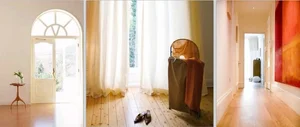
What Your Complaint Might Also Be Telling You About Your Home
For the past 10 years I've worked as a classical homeopath. For almost as long, I've also read rooms, trained first as an artist, then in the ancient art of Feng Shui. Most people assume these are two separate parts of my work, but in practice, they're two lenses, pointed at different angles of the same person.
A homeopathic case-taking asks: what is the pattern underneath the symptom? Not just "I have trouble sleeping," but how, exactly? Do you wake at 3am with your mind racing, or do you sleep but never feel rested? Feng Shui asks a structurally similar question about a home: not just "this room feels off," but how, exactly? Is the Chi stagnant in a cluttered corner, or is it scattered because there's no clear center to the space at all?
When I sit with a patient, I'm often quietly running both analyses. Someone describing chronic, low-grade exhaustion that "crept up over the years" will sometimes, almost in passing, mention that their home office is in a windowless basement room, or that they've been meaning to clear out a room full of a deceased parent's belongings for three years. In classical homeopathic terms it can echo the same suppressed, unprocessed quality the remedy picture is pointing at. In Feng Shui terms, it's stagnant Chi in a space that's blocking the person’s energy flow.
I don't treat the home instead of the person, and I don't ask people to redecorate their way out of a health complaint. But when the two pictures - the constitutional remedy picture and the spatial one - point in the same direction, it tells you something a symptom list alone doesn't: that the pattern isn't only internal, and that real, lasting change may need to happen on both levels in order to create a lasting, deep energetic shift.
A short example of how this shows up in practice:
A patient came to me with stress-related sleep disruption that hadn't responded to the usual approaches. During the case-taking, she mentioned - almost as an aside - that she'd moved her desk into her bedroom eight months earlier "because it was more practical," right around when the sleep problems started. From a Feng Shui perspective, that's a direct conflict: a space meant for rest (Yin) now also holds the unfinished business of the working day (Yang). From a homeopathic perspective, her remedy picture centered on an inability to switch off, a mind that stayed "on duty." Both pointed at the same theme, from different angles. The remedy addressed the internal pattern; moving the desk back out addressed the environmental one. Neither alone would have told the full story.
Where philosophy fits in
During the many years of working with people - and also with my own stuff - I realize what it actually means to attend to another person without immediately trying to fix them. That's shaped how I hold both homeopathic case-taking and a Feng Shui walkthrough: not as diagnosis-and-prescription, but as sacred attentiveness to the ordinary. Taking seriously that where someone keeps their shoes, or how they describe their fatigue, is worth listening to carefully, on its own terms, before reaching for a solution.
This is also why I don't practice Feng Shui as a checklist of placements ("mirror here, plant there") divorced from the person living in the space, and I don't practice homeopathy as symptom-matching divorced from how someone actually lives. The map is only useful if it's a map of this particular person's terrain: their body and their rooms both.
If you recognise this pattern in your own life, a health complaint that's dragged on despite the usual approaches, alongside a home that no longer feels like it's supporting you, dont hesitate to reach out and see if I can help you.